Posts

Showing posts with the label po polsku

bilberry / blueberry - jagoda / borówka

Image
 Dictionaries in print and online, including Google translate, seem to be at odds with what native Polish speakers call these fruits. Bilberries (on the left) are called jagody (jagoda, singular).  According to wiktionary, this is a colloquial use.  Bilberries are smaller than blueberries and tend to be foraged and not widely sold in the shops.  You may find them sold by volume in markets.  They are the essential ingredient for jagodzianki - bilberry filled buns. Blueberries (on the right) are called borówki (borówka, singular). They are larger and sold widely. Bilberry (Vaccinium myrtillus) - jagoda The common bilberry is a deciduous ( liściasty in Polish), suckering shrub (it can send up new shoots from its roots around the perimeter of the original plant.  It has glossy green leaves, wider at the base, tapering to the apex, often turning red / orange in autumn and blue-black berries.  Tends to be 10cm to 50cm tall. Blueberry   (Vaccinium c...

To roast - piec / upiec

Image
As a verb,  piec is the imperfective form upiec is the perfective form I am an Englishman, therefore... piekę wołowinę     -     I am roasting beef piekłem wołowinę     -     I was roasting beef upiekłem wołowinę     -     I roasted beef będę piec wołowinę     -     I'll be roasting beef upiekę* wołowinę     -     I'll roast beef      [*amended, dzięki Tomaszowi]

Engrossed - pochłonięty

Image
I was totally engrossed in the book, it was fascinating. To be engrossed in something is to have all your attention in it.  When I am engrossed in a book, I don't notice if someone is trying to talk to me. People can be engrossed in conversation (especially if it is gossip) Gossip is a kind of conversation, often about other people's private lives and rumour. If people are engrossed in conversation it is probably salacious gossip. Salacious is an adjective to describe the topic as being of a sexual nature. Byłem całkowicie pochłonięty tą książką, ona była fascynująca. Być pochłoniętym czymś , to mieć całą swoją uwagę w czymś.  Kiedy jestem pochłonięty książką, nie zauważam kiedy ktoś mówi do mnie. Ludzie mogą być pochłonięci rozmową (szczególnie jeżeli jest to plotkowanie) Plotkowanie to rodzaj rozmowy, często o prywatnym życiu innych ludzi i plotkach. Kiedy ludzie są pochłonięci rozmową, to jest to prawdopodobnie lubieżna (sprośna) plotka. Lubieżny to przymiotni...

Świnka Peppa - Pływanie

Image
Peppa Pig - Swimming Initially, I thought the Polish version of Peppa Pig, always had Peppa's little brother George called Jacek.  However, there are plenty of episodes where he is called George.   Pływanie.   Swimming Vocabulary Deseczka - diminutive of deska - board / float.  Deska na basen / Deska do pływania Motylki - Butterflies , but refers to motylki do pływania - water wings / armbands Spróbować - to try Nurkować - to dive Chlapać - to splash (imperfective) (Po)skakać - to jump (Po)patrzeć - to take a look Głuptas - silly (noun) Doskonały - perfect (Po)trzymać - to hold  Widok - view (noun) Bliżej - closer Suszyć - to  dry Konewka - watering can Polewać - to wet  by pouring Upuścić - to drop / let go of Umieć - to know (have learnt) Potrafić - to be able / can  (auxiliary verb) Trafić - to hit (the target etc) Po polsku / in Polish Jestem Świnka Peppa I'm Peppa Pig To mój mały brat George This is my little brother George T...

Świnka Peppa - Jacek jest przeziębiony

Image
Peppa Pig - George has a cold. Firstly, in some Polish versions of Peppa Pig, her little brother George is called Jacek. In my translations into English I will use George.  The diminutive form of Jecek is Jacuś, like saying Georgie.  Jacek jest przeziębiony.   Przeziębienie is a cold.  Przeziębiony is an adjective form.  Literally: George is coldy, but best translation is: George has a cold.  In the original English, the title is George Catches a Cold. Po polsku / in Polish Jestem Świnka Peppa I'm Peppa Pig To mój młodszy brat Jacek This is my younger brother George To Świnka Mama This is Mummy Pig A to Świnka Tata And this is Daddy Pig Ale dzisiaj leje! Oh, today it's pouring! Ale means but, but is also used at the beginning of statements for emphasis. Peppo, Jacku! Włóżcie płaszcze od deszczu Peppa, George! Put on [your] raincoates Kiedy pada deszcz, Peppa i Jacek muszą włożyć nieprzemakalne ubrania When it rains, Peppa and George must put...

Family - Rodzina

mother matka father ojciec mum mama dad tata daughter córka son syn sister siostra brother brat grandma babcia grandad dziadek aunt ciocia uncle wujek male cousin kuzyn female cousin kuzynka mother-in-law teściowa father-in-law teść sister-in-law szwagierka brother-in-law szwagier

Sandwich from mosquitoes

Image
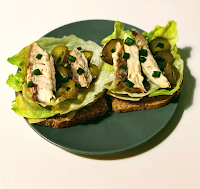
A sandwich (kanapka) in Poland, tends to be an open sandwich; toppings sitting on a slice of bread, like a large canapé. In fact the word kanapka is the diminutive form of kanapa (sofa) which itself comes from the French word, canapé, for sofa. Its resemblance to the word canopy is no mere coincidence. A mosquito net over a bed was called a canopy from the Ancient Greek word, konops, for mosquito. Over time the word for the canopy over the bed, came to be used for the bed itself, then finally came to mean sofa. So the toppings of canapés and kanapki sit on little beds of bread.  I first heard the etymology of canapé from Something Rhymes with Purple , a splendid podcast by Susie Dent and Gyles Brandreth. 

One Way. How does one say one as a pronoun in Polish?

Image
These days, one  as a pronoun, tends to be avoided by the English masses, perhaps because it is viewed as sounding pretentious, but for most people it has been replaced by y ou  without much confusion when in context. A Polish friend once told me there is no direct equivalent to one in Polish.  I assume the Polish don't literally say, for example, where do you buy books  (when meaning where does one buy books) which would be Gdzie kupujesz książki?   Which I believe only means, where does the person you are asking buy books?  So, if that's no good and we can't ask where does one buy books?  then a different phrasing is required. Where are books bought?  Typed into Google Translate comes up with Gdzie kupuje się książki?  kupuje is conjugated as for the third person, as you would for one as a pronoun How is bread made? Jak się robi chleb? again, robi is the conjugation for the third person and się pops up again So się acts lik...